
COPD and Nutrition: What & How Should a Person With COPD Eat?

If you or someone you love has COPD, you’ve probably heard a lot about inhalers, oxygen levels and breathing exercises. Food tends to come up last, if at all. Maybe a quick “eat healthy” at the end of a consultation.
That’s a pity, because what a person with COPD eats (and how much of it they manage to finish) has a real say in how strong they feel, how well they recover from flare-ups and how much of their day they can get through. A good diet and nutrition in COPD isn’t about a special superfood. It’s about getting enough protein and energy into a body that’s working harder than most, often while appetite quietly shrinks.
Why do people with COPD lose weight and muscle?
Here’s something that surprises a lot of families. Breathing, for a person with COPD, is hard physical work. The breathing muscles are pushing against narrowed, stiff airways all day and all night. That extra effort burns extra energy, even when someone is just sitting in a chair watching TV.
 At the same time, eating gets harder. A full stomach pushes up against the diaphragm and makes breathing feel tighter. Chewing and swallowing while breathless is tiring. Many people feel full after a few bites. Some medicines affect taste or cause a dry mouth. Put those together and you get a gap: the body needs more, but gets less.
When that gap goes on for weeks and months, the body starts using its own muscle as fuel. This is one of the main ways COPD affects the body outside the lungs [1, 2], and once muscle goes, a chain reaction starts.
Researchers describe this as one of the most important effects of COPD outside the lungs [1, 2].
The COPD muscle-loss cycle: higher energy needs and lower food intake lead to muscle loss, less activity and more symptoms.
Alt text: Diagram of the COPD muscle-loss cycle showing six steps from rising energy demand to worsening symptoms
The good news is that this cycle can be broken in more than one place. Medicines and breathing rehabilitation help. So does food, and food is the part you control at home, every day. Weight loss is also worth taking seriously: people with COPD who lose weight tend to do worse, and those who put weight back on tend to do better [3].
How much protein does a COPD patient need every day?
This is the question we hear most often, so let’s be specific.
The standard recommendation you see on food packets (the RDA) is designed for healthy adults. It’s roughly 0.8 to 1.0 grams of protein per kilogram of body weight a day. For someone with COPD, especially someone older, underweight or losing muscle, that’s usually not enough.
Clinical reviews suggest a COPD protein requirement of around 1.2 to 1.5 g of protein per kg of body weight per day for people who are nutritionally vulnerable or losing muscle, alongside energy intake of roughly 30 kcal per kg to maintain weight (and more, up to around 45 kcal per kg, when weight needs to be regained) [1, 4]. Expert groups on healthy ageing land in a similar place: 1.0 to 1.2 g/kg for healthy older adults and 1.2 to 1.5 g/kg for older people with acute or chronic illness [5, 6].
So how much protein for COPD does that actually mean? Here’s a quick way to see it.
Body weight | Protein at 1.2 g/kg | Protein at 1.5 g/kg | Energy to maintain weight (~30 kcal/kg) |
|---|---|---|---|
40 kg | 48 g | 60 g | ~1,200 kcal |
50 kg | 60 g | 75 g | ~1,500 kcal |
55 kg | 66 g | 83 g | ~1,650 kcal |
60 kg | 72 g | 90 g | ~1,800 kcal |
70 kg | 84 g | 105 g | ~2,100 kcal |
These are general ranges from clinical literature, not a prescription. People with kidney disease or other conditions may need different targets, so check with your doctor or dietitian first.
Now picture a typical day in an Indian home: tea and two biscuits, a couple of idlis, a roti with sabzi at lunch, some dal and rice at night. That might add up to 35 to 45 grams of protein. Against a target of 72 to 90 grams, you can see the gap straight away. It helps to put some protein in every meal instead of saving it all for dinner [7].
Why the weighing scale can miss muscle loss
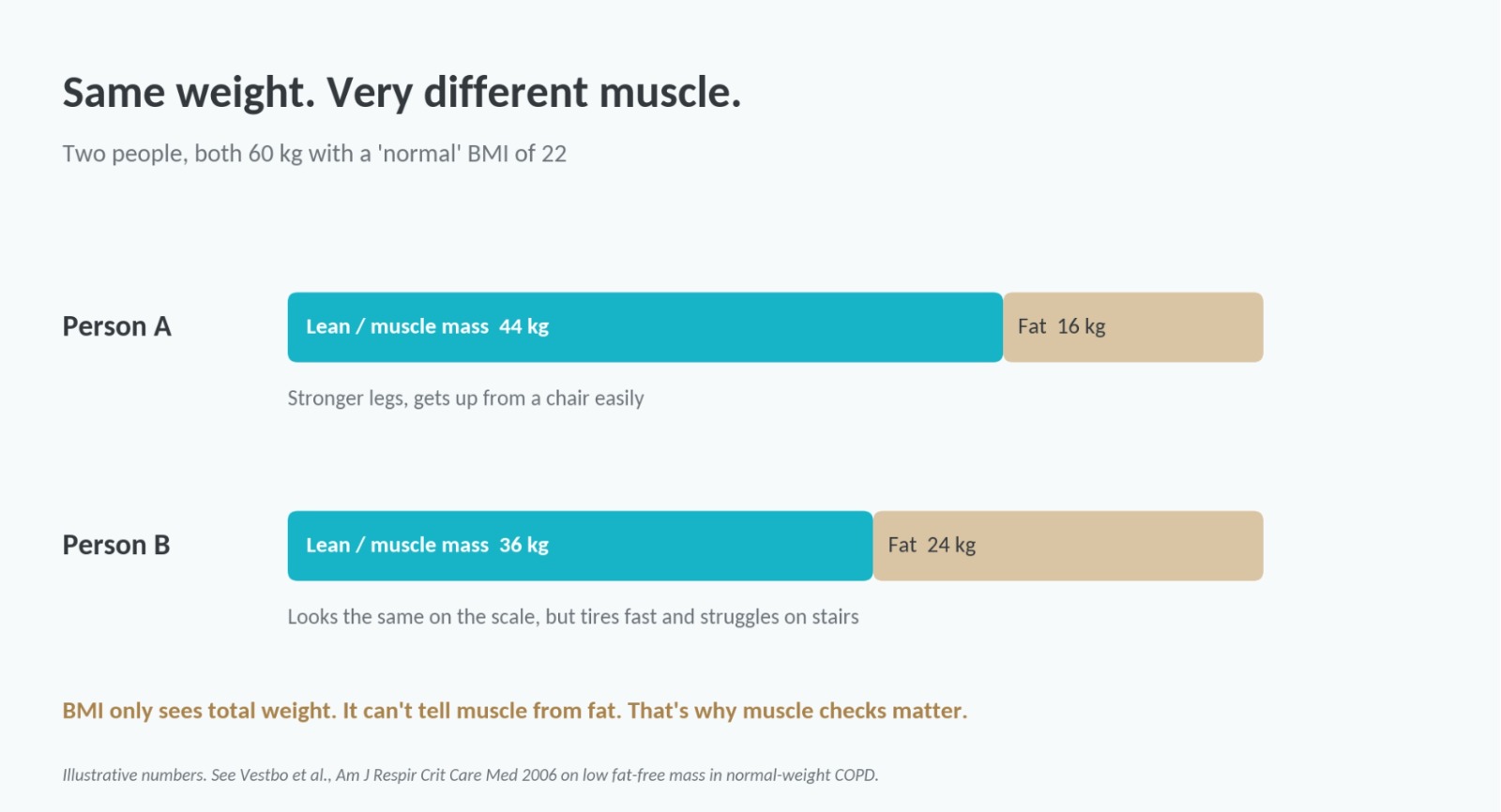
Doctors call this muscle loss condition sarcopenia: the lose of both muscle and strength. It’s common with age, and COPD speeds it up. About one in five people with COPD has it [8], which shows up as weaker legs, more falls and a slower recovery after every illness.
Unintentional weight loss in COPD: when should families be concerned?
Most families notice weight loss late. Clothes get loose. A watch strap needs a new hole. A relative visiting after a few months says, “He’s looking thin.”
 Unexplained weight loss shouldn’t be brushed off as “just age.” A useful rule: losing more than 5% of body weight in six months without trying is a warning sign [9]. For a 60 kg person, that is just 3 kg. If weight keeps sliding, it is worth acting early rather than waiting for the next appointment.
A simple weekly weight tracker. The trend matters more than any single reading
Red-flag checklist: call the doctor if you notice
- Weight down more than 5% in 6 months, or 2 to 3 kg in a month without trying
- Eating less than half of usual meals for more than a week
- New trouble swallowing, or coughing and choking while eating
- A fall
COPD appetite loss is common, but it’s not something to simply live with. The earlier it’s caught, the easier it is to turn around.
COPD food chart: what to eat, what to limit, and why
Here’s a practical COPD food chart built around everyday Indian foods. Think of it as a guide, not a rulebook.
Food group | Eat more of | Limit or watch | Why it matters |
|---|---|---|---|
Protein | Veg sources: Dal, rajma or chana (if they suit the stomach), paneer, curd, soya chunks, sattu, besan chilla, milk Non-veg sources: Eggs, Fish, Chicken. | Skipping protein at breakfast and snacks | Protein is the raw material for muscle, including breathing muscles |
Energy | Ghee or oil added to dal and sabzi, nuts, peanut chikki, nut butters, full-fat curd (if underweight) | Filling up on low-calorie foods like thin soups or plain salads | Enough energy stops the body from burning protein and muscle for fuel |
Meal size | 5 to 6 small meals and snacks | 2 to 3 very large meals | A full stomach presses on the diaphragm and makes breathing harder [10] |
Salt | Home-cooked food with moderate salt | Pickles, papad, namkeen, instant noodles, packaged snacks | Too much salt can cause fluid retention and swelling [10] |
High-protein supplements for COPD: what should you actually look for?
Food comes first. But sometimes food alone can’t close the gap, especially when appetite is low, breathing is hard, or someone is recovering from a flare-up. Studies show that nutritional supplements can help people with COPD take in more overall and put on weight [1, 11]. If you think one is needed, ask the doctor or dietitian first, and treat it as something you add to meals, not a replacement for them.
If a supplement is advised, these are the things worth checking:
Protein. How many grams per serving, and is it good-quality protein such as whey [12, 13]?
Calories. A small serving that gives plenty of energy is easier than a big glass that gives little, especially for someone who fills up fast.
Ease of use. Anything that needs mixing, shaking and washing up is one more chore on a tiring day, and something they like the taste of is something they will keep taking [14].
Frequently asked questions
What is the best diet for COPD patients?
There’s no single diet recommendation in COPD patient. The best approach is a balanced diet with enough protein (often 1.2 to 1.5 g/kg a day for people at nutritional risk) and enough energy, eaten as 5 to 6 small meals rather than 2 or 3 large ones.
What can I give an underweight person with COPD to help them gain weight?
Start with food: smaller meals more often, enough protein in every meal, and extra energy added to what they already eat (ghee in dal, nuts, full-fat curd). A concentrated high calorie nutrition with enough protein in a ready-to-eat format like paste or a drink may be easier. Ask the doctor or dietitian which suits, especially if there’s diabetes or kidney disease.
References
- Collins PF, Yang IA, Chang YC, Vaughan A. Nutritional support in chronic obstructive pulmonary disease (COPD): an evidence update. J Thorac Dis. 2019;11(Suppl 17):S2230–S2237.
- Schols AM, Ferreira IM, Franssen FM, et al. Nutritional assessment and therapy in COPD: a European Respiratory Society statement. Eur Respir J. 2014;44(6):1504–1520.
- Schols AM, Slangen J, Volovics L, Wouters EF. Weight loss is a reversible factor in the prognosis of chronic obstructive pulmonary disease. Am J Respir Crit Care Med. 1998;157(6):1791–1797.
- Hegelund MH, Ryrsø CK, Ritz C, et al. Multidimensional individualized nutritional therapy for individuals with severe chronic obstructive pulmonary disease: study protocol for a registry-based randomized controlled trial. Trials. 2023;24(1):86.
- Bauer J, Biolo G, Cederholm T, et al. Evidence-based recommendations for optimal dietary protein intake in older people: a position paper from the PROT-AGE Study Group. J Am Med Dir Assoc. 2013;14(8):542–559.
- Deutz NE, Bauer JM, Barazzoni R, et al. Protein intake and exercise for optimal muscle function with aging: recommendations from the ESPEN Expert Group. Clin Nutr. 2014;33(6):929–936.
- Paddon-Jones D, Rasmussen BB. Dietary protein recommendations and the prevention of sarcopenia. Curr Opin Clin Nutr Metab Care. 2009;12(1):86–90.
- Benz E, Trajanoska K, Lahousse L, et al. Sarcopenia in COPD: a systematic review and meta-analysis. Eur Respir Rev. 2019;28(154):190049.
- Cederholm T, Jensen GL, Correia MITD, et al. GLIM criteria for the diagnosis of malnutrition: a consensus report from the global clinical nutrition community. Clin Nutr. 2019;38(1):1–9.
- American Lung Association. Nutrition and COPD. lung.org (accessed September 2026).
- Ferreira IM, Brooks D, White J, Goldstein R. Nutritional supplementation for stable chronic obstructive pulmonary disease. Cochrane Database Syst Rev. 2012;12:CD000998.
- FAO. Dietary protein quality evaluation in human nutrition: report of an FAO Expert Consultation. FAO Food Nutr Pap. 2013;92.
- Devries MC, Phillips SM. Supplemental protein in support of muscle mass and health: advantage whey. J Food Sci. 2015;80(Suppl 1):A8–A15.
- Hubbard GP, Elia M, Holdoway A, Stratton RJ. A systematic review of compliance to oral nutritional supplements. Clin Nutr. 2012;31(3):293–312.