
What Is Specialised Nutrition, and When Is It Non-Negotiable?

“Just give her good home food. Dal, rice, a little ghee. She’ll get her strength back.”
It’s something families say all the time, and most of the time it’s good advice. Home food is nourishing, comforting and familiar. But there are moments when the body is under so much strain that ordinary meals may not provide enough energy and protein to meet increased nutritional needs. This is particularly true after a viral illness, after major surgery, during cancer treatment, or when a parent in their eighties has been losing muscle for a year.
In those moments, specialised nutrition stops being a “nice to have” and becomes an important part of nutrition care. This article explains what it is, how it’s different from a regular protein powder, and the situations where clinical guidelines say it really matters.
What is specialised nutrition?
Let’s start with a plain definition. Specialised nutrition (sometimes called medical nutrition or part of medical nutrition therapy) refers to foods and formulas made for people with specific health needs. They’re designed to deliver the right mix of energy, protein and nutrients in a form the person can actually take, whether that’s a small portion, a particular texture or a ready-to-eat format that doesn’t need preparation.
In India, these products are sold under food safety rules as Food for Special Dietary Use or Food for Special Medical Purpose [1]. The label matters less than the idea: they are meant to be used on a doctor’s or dietitian’s advice, not picked off a shelf like a snack.
Specialised nutrition vs protein powder: what's the difference?
This is where a lot of confusion lives. A tub of protein powder from the gym aisle and a clinical nutritional product may both say “high protein,” but they’re built for people with different nutritional purposes.
| Regular protein powder | Specialised nutrition |
Designed for | Healthy, active adults, often gym-goers | People with illness, frailty, recovery needs or low appetite |
Main focus | Protein only | Protein and energy, plus vitamins and minerals |
Serving | Usually mixed into a large glass of water or milk | Often small, concentrated or ready to eat |
Used | Self-chosen | Ideally on the advice of a doctor, dietitian or nutritionist |
When is specialised nutrition needed? Three key situations
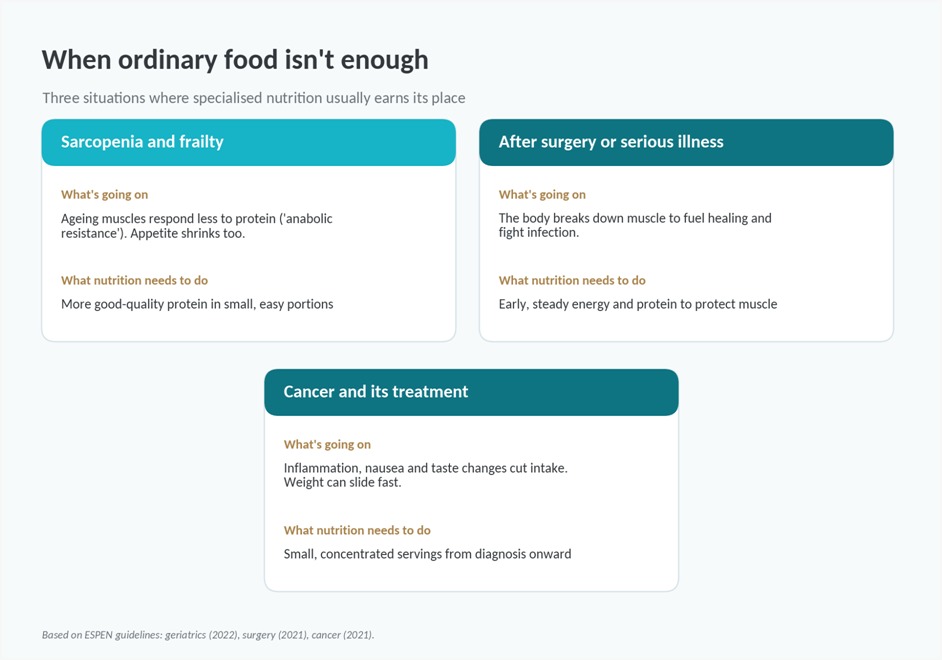
Four situations where specialised nutrition is often needed.
1. Sarcopenia and frailty in older adults
What’s happening: with age, muscles become less responsive to food than they once were [2]. An older body needs a bigger helping of good protein at a meal to get the same repair signal [3]. Appetite shrinks at the same time, teeth may be a problem, portions get smaller, and muscle quietly slips away. Doctors call this sarcopenia.
What helps: experts suggest older adults get at least 1.0 g of protein per kg of body weight a day, and 1.2 to 1.5 g/kg if they are ill [4, 5]. Quality counts as well as quantity: proteins like whey are well digested and provide leucine that stimulates muscle building.
For high protein food for elderly with low appetite, the goal is concentrated nutrition in small, easy portions, combined with some regular movement. Protein works best for muscle when muscles are also being used. That’s the job protein supplements for older adults are built for: a top-up between meals, not a replacement for them.
2. Recovery after surgery or serious illness
What’s happening: after surgery, injury or a serious infection, the body may increase protein breakdown and lose muscle mass, particularly when nutritional intake is inadequate. A few days in bed makes it worse: ten days of bed rest in healthy older adults may result in a measurable loss of leg muscle and strength [6].
What helps: ESPEN’s (European Society for Clinical Nutrition and Metabolism) practical guideline on surgery encourages avoiding long periods of fasting, restarting oral food as early as possible after surgery, and using oral nutritional supplements for patients who are at nutritional risk or can’t meet their needs through food. For people who are already malnourished before a major operation, it recommends nutritional support for 7 to 14 days before surgery where possible [7].
Post surgery recovery nutrition guidelines in practice come down to a few things: start eating early, prioritise protein, keep portions manageable, and keep going for weeks, not days. Recovery doesn’t end when the stitches come out. A high protein supplement for recovery can help close the gap.
3. Cancer and cancer cachexia
What’s happening: cancer and its treatment can make eating very hard. Nausea, mouth sores, taste changes and constant fullness cut intake, while cancer-related metabolic changes can contribute to loss of muscle and other lean tissue. Severe weight and muscle loss of this kind is called cachexia.
What helps: guidelines advise checking nutrition right from diagnosis, aiming for more than 1 g of protein per kg a day, and adding supplements when food alone isn’t enough [8].
A high-protein diet for people with cancer cachexia isn’t about forcing big meals. It’s about small, frequent, concentrated servings that are easy to face on a bad day. Ready-to-eat formats that don’t need mixing or measuring can help when energy is low and the smell of cooking is hard to bear.

When does specialised nutrition become non-negotiable?
Here are the signs that it’s time to talk to a doctor or dietitian about specialised nutrition, rather than simply “trying to eat more”:
- Weight has dropped more than 5% in six months without trying [9]
- You are undergoing chemotherapy or radiation therapy and struggling to meet your nutritional needs
- A long-term illness is present along with poor appetite
If any two or more of these apply, it’s worth seeking nutritional assessment with the doctor or a dietitian at the next visit, or sooner.
This article is for general information and doesn’t replace medical advice. Please speak with your doctor or dietitian before starting any specialised nutrition product.
References
- Food Safety and Standards Authority of India. Food Safety and Standards (Health Supplements, Nutraceuticals, Food for Special Dietary Use, Food for Special Medical Purpose, and Prebiotic and Probiotic Food) Regulations, 2022. fssai.gov.in.
- Cuthbertson D, Smith K, Babraj J, et al. Anabolic signaling deficits underlie amino acid resistance of wasting, aging muscle. FASEB J. 2005;19(3):422–424.
- Moore DR, Churchward-Venne TA, Witard O, et al. Protein ingestion to stimulate myofibrillar protein synthesis requires greater relative protein intakes in healthy older versus younger men. J Gerontol A Biol Sci Med Sci. 2015;70(1):57–62.
- Volkert D, Beck AM, Cederholm T, et al. ESPEN practical guideline: Clinical nutrition and hydration in geriatrics. Clin Nutr. 2022;41(4):958–989.
- Bauer J, Biolo G, Cederholm T, et al. Evidence-based recommendations for optimal dietary protein intake in older people: a position paper from the PROT-AGE Study Group. J Am Med Dir Assoc. 2013;14(8):542–559.
- Kortebein P, Ferrando A, Lombeida J, Wolfe R, Evans WJ. Effect of 10 days of bed rest on skeletal muscle in healthy older adults. JAMA. 2007;297(16):1772–1774.
- Weimann A, Braga M, Carli F, et al. ESPEN practical guideline: Clinical nutrition in surgery. Clin Nutr. 2021;40(7):4745–4761.
- Muscaritoli M, Arends J, Bachmann P, et al. ESPEN practical guideline: Clinical Nutrition in cancer. Clin Nutr. 2021;40(5):2898–2913.
- Cederholm T, Jensen GL, Correia MITD, et al. GLIM criteria for the diagnosis of malnutrition: a consensus report from the global clinical nutrition community. Clin Nutr. 2019;38(1):1–9.