
The Caregiver's Guide: Supporting Strength Between Doctor Visits

A doctor’s appointment lasts maybe fifteen minutes. Perhaps twenty if you’re lucky and the waiting room is quiet. Then you go home, and there are weeks, sometimes months, until the next one.
That stretch in between is where most of the real work happens. It’s where medicines are taken (or forgotten), where walks happen (or don’t), where meals get finished (or pushed around the plate). And the person who sees all of it, day after day, is usually not the doctor. It’s you.
If you’re caring for a parent, spouse or relative who is older, living with a long-term illness, or recovering from a hospital stay, this caregiver guide is for you. It’s about helping someone hold on to their strength at home, noticing problems early, and making each doctor’s visit count.
Why the time between visits matters so much
Here’s something doctors know well but families often don’t. The numbers that get checked at the clinic (oxygen level, blood pressure, lung function, weight) are snapshots. They show how someone is doing on that one morning.
What they don’t show is the slow drift. The fact that your mother now stops twice on the stairs instead of once. That your father has stopped going for his evening walk. That the steel katori of dal comes back half full most nights. These changes are small, gradual and easy to explain away. But added together, they tell the real story.
Muscle, in particular, slips away quietly. Even ten days of bed rest costs healthy older adults a measurable amount of leg muscle and strength [1], and for someone already frail that is hard to win back.
The three pillars of strength at home
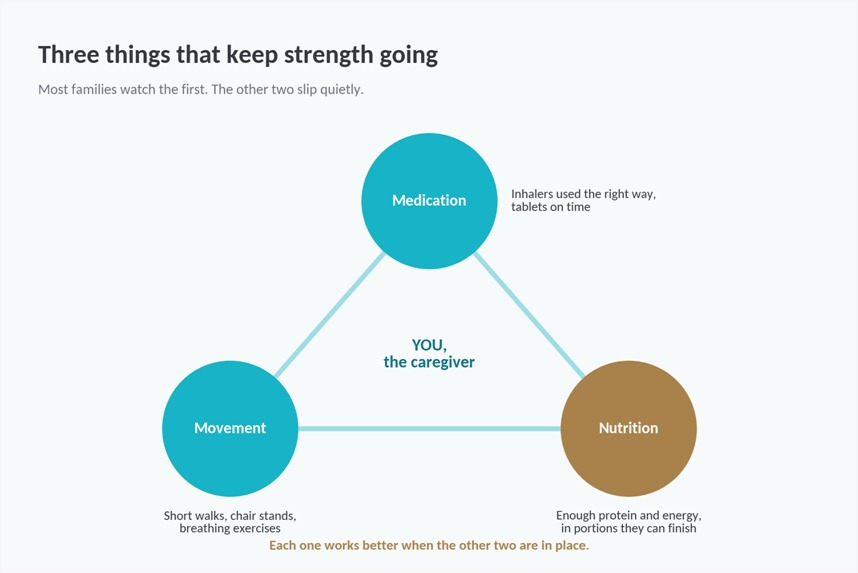
Think of it as a three-legged stool. If one leg is short, the whole thing wobbles.
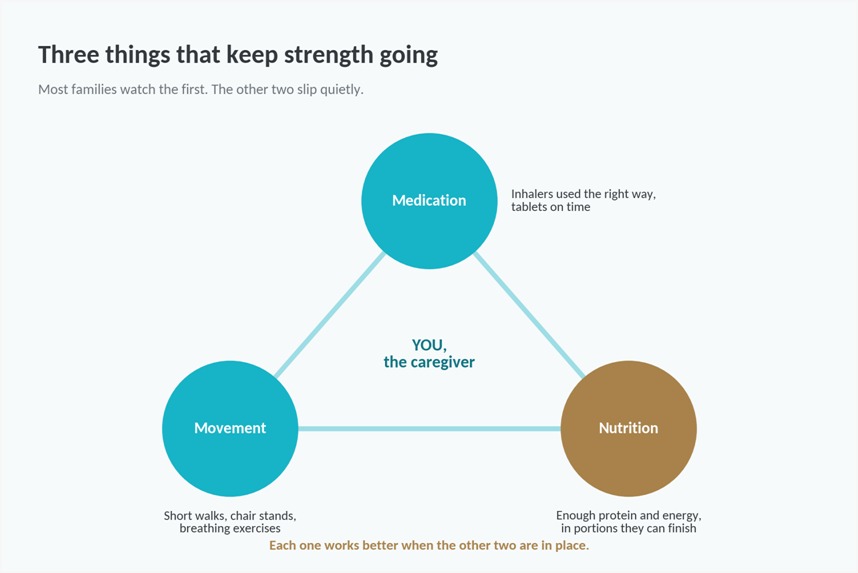
needs vary from person to person, so always follow your doctor’s advice.
Pillar 1: Medication, taken the right way
Most families are quite careful about medicines, and that’s good. But “taking the medicine” and “taking it correctly” aren’t always the same thing.
On average only about half of people with long-term illnesses take their medicines as prescribed [2], and only about a third use their inhaler correctly [3], which means far less medicine reaches the lungs than anyone realises.
Illustrative example: The COPD-related information in this section is intended as an illustrative example. Individual needs vary, so always follow your doctor’s advice.
2. Recovery after surgery or serious illness
A simple weekly check caregivers can do at home.
What you can do:
- Ask the doctor or pharmacist to watch your loved one use their inhaler, and correct the technique.
- Note any side effects, like dry mouth, taste changes or poor appetite, because these affect eating too.
Pillar 2: Movement, mild physical activity or exercise - a little every day
Movement is medicine for muscles. Supervised exercise programmes can help people with a medical condition breathe more easily and move better [4], and even small amounts of daily movement at home can help people improve their physical function. Protein works best when muscles are actually used [5].
What you can do:
- Encourage a short walk every day, even if it’s just to the gate and back, and slowly build up.
- Try “chair stands”: standing up and sitting down from a sturdy chair a few times, twice a day.
Pillar 3: Nutrition, enough protein and energy
This is the pillar that most often gets forgotten, because it doesn’t come with a prescription.
Older adults, and especially those with chronic illness, usually need more protein than younger people, not less: roughly 1.0 to 1.2 g per kg of body weight for healthy older adults and 1.2 to 1.5 g/kg for those with acute or chronic illness [6]. However, nutrition must be individualised according to the patient’s nutritional status, physical activity, disease status, and tolerance.
At the same time, appetite tends to shrink with age and illness. That’s the gap caregivers can help close. Some loss of muscle with age happens to everyone, and nutrition for age related muscle loss won’t stop the clock. What it can do is make sure the slide is slow rather than steep.
The 10-minute weekly check
You don’t need medical training to keep an eye on the things that matter. You just need a notebook, a bathroom scale and ten minutes once a week.
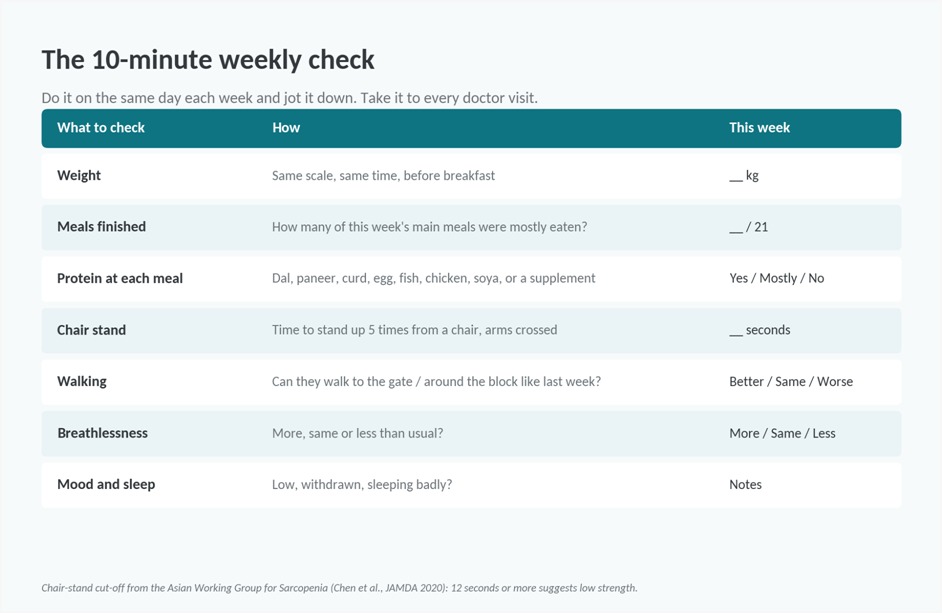
A simple weekly check caregivers can do at home.
Weight: Weigh on the same day, at the same time (before breakfast is easiest), on the same scale. One reading doesn’t mean much. The trend over a month or two does. Doctors commonly treat unintentional weight loss of more than 5% in six months as a warning sign of malnutrition [7]. For a 60 kg person, that’s only 3 kg.
Chair stand: Time how long it takes to stand up and sit down five times from a firm chair, arms crossed, with you close by for safety. The Asian Working Group for Sarcopenia uses 12 seconds or more as a sign of reduced strength [8]. More useful than any single number is whether it’s getting slower.
When appetite is low: practical tips that work
Low appetite is one of the hardest things to deal with as a caregiver. You cook with love, and the plate comes back barely touched. It’s frustrating, and it’s worrying. Here are ideas that help many families.
Go small and frequent. Five or six small meals are easier than three big ones. A small plate that gets finished feels better than a big one that doesn’t.
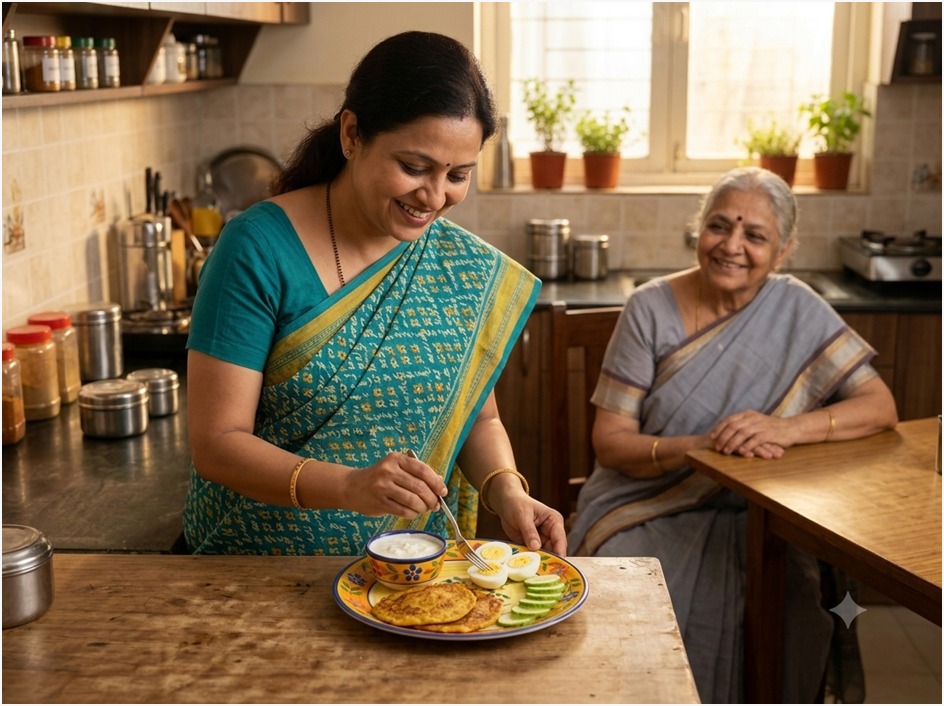
Make every bite count. Add a spoon of ghee to dal, paneer to sabzi, roasted chana or peanuts to poha, milk instead of water to atta. Small changes add up without making the plate bigger.
Protein first. If they can only manage a few bites, let those bites be the dal, egg or paneer, then the roti or rice.
Ask about supplements. If food alone isn’t enough, ask the doctor or dietitian whether a nutritional supplement would help. The ones that work best in practice are small, easy to take and rich in both protein and calories, and they are meant to be taken as an addition to food rather than a replacement.
Making the most of every doctor visit
- Doctors are busy, and appointments go fast. Walking in with a short written summary helps you cover what matters and helps the doctor make better decisions.
Take along:
- Your weekly check notes (especially the weight trend)
- A list of all current medicines and supplements
- Your top two or three questions, written down
Questions worth asking:
- “Are they getting enough protein for their condition? How much should they aim for?”
- “What signs should make us call you sooner?”
Red flags: when not to wait for the next visit
Some changes shouldn’t wait for the next scheduled appointment.
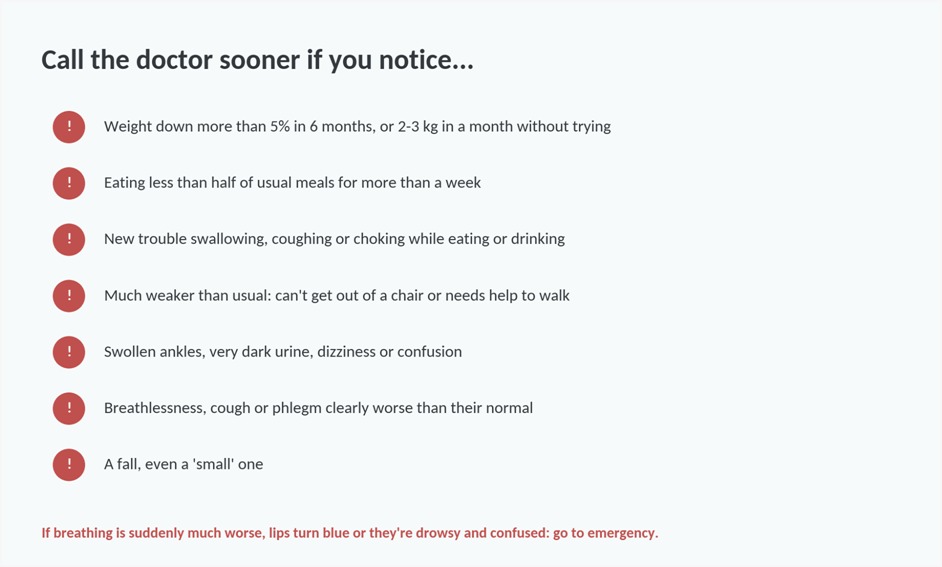
Red flags that mean it’s time to call the doctor sooner.
Look after yourself, too
This part often gets skipped, so we’ll say it plainly: caregiving is hard work. Research shows that family caregivers often carry real physical and emotional strain, including stress, poor sleep and neglect of their own health [9]. You can’t pour from an empty cup.
- Share tasks with siblings, relatives or neighbours, even small ones.
- Talk to someone, whether a friend, a support group or a counsellor, if you’re feeling overwhelmed.
Caring well for someone else includes caring for the person doing the caring.
A little help between visits: the Emprana Care Hub
To make the in-between weeks a bit easier, Emprana offers the Emprana Care Hub on WhatsApp. It’s designed to stay with patients and families between consultations, with:
- Emprana Nutri-Track to help keep track of progress
- Reminders to help with daily routines
- Everyday nutrition tips for real Indian homes
Frequently asked questions
How can I help my elderly parent regain strength at home?
Focus on three things: make sure medicines are taken correctly, encourage gentle daily movement like short walks and chair stands, and include a protein food at every meal. Keep a weekly record of weight and strength to share with the doctor.
How do I avoid caregiver burnout?
Share tasks, take regular breaks, look after your own health and ask for support when you need it. Burnout is common, and asking for help is a sign of good caregiving, not weakness.
How do I manage fatigue and muscle loss in seniors?
Work on all three pillars at once: medicines taken correctly, a little movement every day, and enough protein and energy at each meal. Track weight and the chair stand test weekly so you can see whether things are improving. If fatigue is new, sudden or severe, get it checked, since anaemia, thyroid problems, infection and depression can all look like plain tiredness.
What can I give an elderly parent for weakness?
Start with protein at every meal. If you are a vegetarian, you can take dal, curd, paneer, or soya; or if you are a non-vegetarian, you can take eggs, fish, and chicken. Take small, frequent portions if appetite is low. A nutrition drink for weakness or another supplement can help when food alone isn’t enough.
This article is for general information and doesn’t replace medical advice. Please consult your loved one’s doctor about any changes to diet, activity or medication.
References
- Kortebein P, Ferrando A, Lombeida J, Wolfe R, Evans WJ. Effect of 10 days of bed rest on skeletal muscle in healthy older adults. JAMA. 2007;297(16):1772–1774.
- World Health Organization. Adherence to long-term therapies: evidence for action. Geneva: WHO; 2003.
- Sanchis J, Gich I, Pedersen S; Aerosol Drug Management Improvement Team (ADMIT). Systematic review of errors in inhaler use: has patient technique improved over time? Chest. 2016;150(2):394–406.
- Spruit MA, Singh SJ, Garvey C, et al. An official American Thoracic Society/European Respiratory Society statement: key concepts and advances in pulmonary rehabilitation. Am J Respir Crit Care Med. 2013;188(8):e13–e64.
- Cermak NM, Res PT, de Groot LC, Saris WH, van Loon LJ. Protein supplementation augments the adaptive response of skeletal muscle to resistance-type exercise training: a meta-analysis. Am J Clin Nutr. 2012;96(6):1454–1464.
- Bauer J, Biolo G, Cederholm T, et al. Evidence-based recommendations for optimal dietary protein intake in older people: a position paper from the PROT-AGE Study Group. J Am Med Dir Assoc. 2013;14(8):542–559.
- Cederholm T, Jensen GL, Correia MITD, et al. GLIM criteria for the diagnosis of malnutrition: a consensus report from the global clinical nutrition community. Clin Nutr. 2019;38(1):1–9.
- Chen LK, Woo J, Assantachai P, et al. Asian Working Group for Sarcopenia: 2019 consensus update on sarcopenia diagnosis and treatment. J Am Med Dir Assoc. 2020;21(3):300–307.e2.
- Schulz R, Sherwood PR. Physical and mental health effects of family caregiving. Am J Nurs. 2008;108(9 Suppl):23–27.